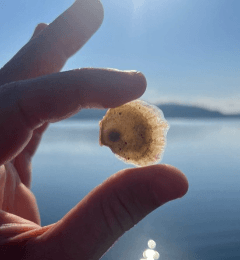
O. edulis is a priority species for restoration across the North-East Atlantic, coordinated through the Native Oyster Restoration Alliance (Pogoda et al., 2019). Restoration is constrained by recruitment: hatchery-reared larvae and spat are costly to produce, and losses at settlement and in the weeks after metamorphosis are high. Early-stage bivalves are particularly sensitive to seawater carbonate chemistry, because initial shell is deposited rapidly with limited physiological control over the calcifying fluid (Waldbusser et al., 2015), and this constraint will intensify under warming and ocean acidification. Settlement is also strongly influenced by the microbial biofilm on the settlement surface, which provides chemical cues to competent larvae.
MAT passes a low-voltage direct current between an anode and a cathodic settlement structure. Reduction of oxygen and water at the cathode raises local pH and precipitates mineral deposits, which are dominated by aragonite at low voltages and by brucite (magnesium hydroxide) at higher voltages (Barchiche et al., 2004). The technique therefore offers a means of modifying surface chemistry, deposit mineralogy and, potentially, the surface biofilm at the point where larvae settle.
The project is interdisciplinary, combining benthic ecology, microbial ecology and marine engineering, and the student will be supervised by a team spanning these fields.
Mineral accretion is increasingly promoted as a restoration tool, but its biological benefits are poorly evidenced. Its operating parameters have largely been inherited from tropical coral work, and the current density at which it benefits, has no effect on, or harms a temperate bivalve is unknown. Without this information, practitioners cannot judge whether the technique should be applied to native oyster restoration, or at what intensity.
The project tests the overarching hypothesis that cathodic current density determines the settlement and early survival of O. edulis through its effects on surface carbonate chemistry, deposit mineralogy and the surface biofilm, and that there is an intermediate current density in which these effects are beneficial. Specifically:
H1. Boundary-layer pH and carbonate saturation state at the settlement surface increase with current density, and the magnesium fraction of surface deposits increases above a threshold current density as deposition shifts from aragonite to brucite.
H2. The composition and development of the surface biofilm community differ along the current-density gradient relative to unpowered controls.
H3. Larval settlement, post-settlement survival and early shell growth are enhanced at low to intermediate current densities relative to unpowered controls, and the benefit declines or reverses at high current densities.
H4. Variation in settlement across treatments is explained by surface chemistry, deposit composition and biofilm composition, and the relative contribution of each can be distinguished.
All work will take place in flow-through seawater mesocosms at SAMS over a 12-month programme.
Experimental system. Settlement surfaces will be held as cathodes under galvanostatic (constant-current) control across a gradient of current densities, from low values through to those at which brucite deposition dominates, alongside unpowered controls built from identical materials. Each treatment will be assigned to separate tanks, avoiding the exposure of controls to stray electrical fields that undermines many field studies (Rivas-Mena et al., 2026). Anodes will be isolated from the larval compartment, and pH and residual oxidants monitored, so that anodic by-products cannot confound biological responses. Current, cell voltage and cathode potential will be logged continuously.
Surface chemistry. Microprofiles of pH and oxygen will be measured through the boundary layer above settlement surfaces using microsensors.
Deposit composition. Deposit mass per unit area and Ca:Mg composition will be quantified for every tank by acid digestion, with carbonate content measured to close the mass balance between carbonate and hydroxide phases. Mineral phases will be confirmed on a subset of samples by FTIR or X-ray diffraction.
Surface biome. Settlement surfaces will be pre-conditioned under treatment before larvae are introduced, so that biofilm and deposits develop as they would in practice. Biofilms will be sampled through the conditioning period and at the point of larval addition. Community composition will be characterised by 16S and 18S rRNA gene amplicon sequencing, capturing bacteria and microeukaryotes such as diatoms, with biofilm biomass measured in parallel.
Biological trials. Hatchery-reared O. edulis pediveliger larvae from a Bonamia-free source will be added to conditioned surfaces during the summer larval season. Settlement will be quantified after the settlement period and spat followed for 8 to 12 weeks to measure survival and shell growth by image analysis. A second settlement run will be conducted if larval supply allows.
Analysis. Tanks will be the experimental unit, with treatments randomised across tanks. Biological responses will be analysed with dose–response models within a generalised linear mixed model framework. Biofilm communities will be analysed with multivariate methods, and the contributions of chemistry, deposit composition and biofilm to settlement assessed in combination. Model structure, the number of current-density levels and replication will be fixed in an analysis plan agreed with the supervisory team before the biological trials begin.
Literature review, permissions and analysis plan (months 1 to 2)
Construction and commissioning of the mesocosm array (months 2 to 4)
Surface conditioning, chemistry and biofilm time series (months 3 to 5)
Larval settlement trials and post-settlement monitoring during the summer larval season (months 5 to 9)
Sequencing, deposit analysis and statistical analysis (months 8 to 10)
Thesis writing and submission, and preparation of a manuscript (months 10 to 12)
Based at SAMS, the successful applicant will work within a multidisciplinary community of postgraduate researchers, marine scientists and professional support staff. Depending on the final scope of the project, SAMS will provide access to relevant specialist laboratories, field equipment, research facilities and environmental data sets.
Funding for this MRes Marine Science covers UHI tuition fees at the Home rate and SAMS additional programme and research costs for the successful candidate.
Please note that funding does not include a stipend, the difference between home and international fees nor any associated visa costs.
Applicants should hold a BSc (Hons) degree at a 2:1 or above, or international equivalent, in marine biology, ecology or a related subject.
The MRes programme is open to UK, EU and international students.
To apply, please complete and submit the following to masters@sams.ac.uk:
• Completed MRes Research Degree Student application form: RD1_Research Degree Student application_AMPERE_SAMS_MRes.docx
• Your CV.
• Copy of all your official degree transcripts and certificates. If you have not yet completed your degree, please send a transcript showing all your modules and grades. If your official certificates/transcripts are not in English, this must be accompanied by a fully certified translation provided by a professional translator/translation company.
• Please ask two Referees to submit a reference for you using: Applicant Reference Request form_MRes.docx. Please ask each Referee to email the form to us directly to masters@sams.ac.uk by the application deadline.
• Applicants whose first language is not English must also have attained a satisfactory standard on an approved test in English (e.g. a minimum IELTS score of 6.5, with no element below 6.0 attained within two years of the programme start date) or be able to demonstrate that they have adequate command of both written and spoken English to follow the programme before an offer of admission will be made. English language requirements - Approved English language qualifications.
• A copy of the photo page of your passport if you are not a UK national. Please see International entry requirements and Visa Advice. Also include any pages which indicate a right of abode in the UK.
These documents must reach us by any deadline advertised. You can send them by email or post.
Interview information
The best candidates on paper will be invited for interview via Teams in the week of 7th December 2026.