SAMS news room
SAMS-led aquaculture innovation project wins collaboration award
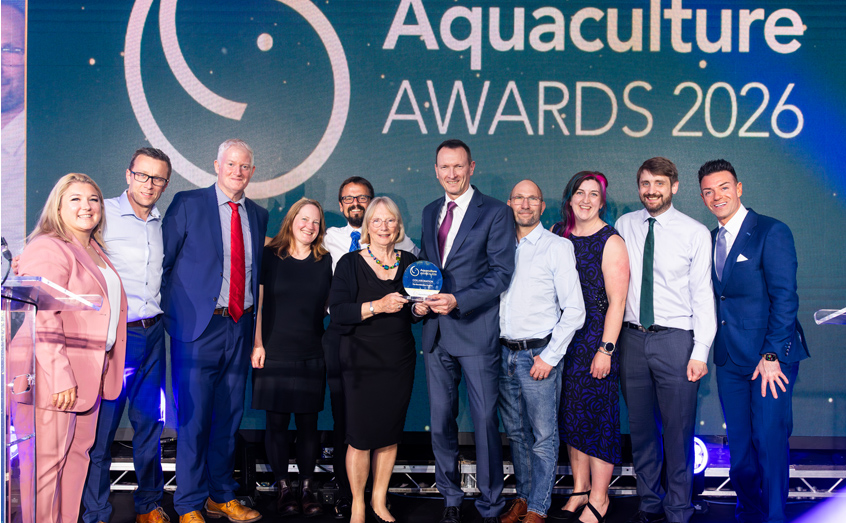
A research project that will revolutionise how seabed health below fish farms is monitored has helped SAMS and its partners to a win at the UK Aquaculture Awards.
The BactMetBar project won the Collaboration Award during the awards night at The Hilton Glasgow on Tuesday.
BactMetBar combined expertise from across research, industry and regulation to devise software that uses machine learning and environmental DNA (eDNA) to quickly check for bacterial diversity in the seabed and use this to predict the health of that environment.
It is a much quicker process than the current method, which requires the sieving of large samples of sediment, the use of toxic chemicals and thorough examination by taxonomists. Recent regulatory changes increased sampling requirements, further stretching capacity and limiting the ability of farmers and regulators to respond quickly to environmental impacts.
The project, was led by SAMS scientist Associate Professor Tom Wilding and partners including the Technical University in Kaiserslautern, MOWI Scotland, UHI’s Institute for Biodiversity and Freshwater Conservation, Scottish Environment Protection Agency, Salmon Scotland and Scottish Sea Farms. It has been funded by the Scottish Aquaculture Innovation Centre.
Associate Professor Wilding said: “We were delighted to win the collaboration award, as it is recognition for our combined efforts to produce high quality scientific outputs that are genuinely impactful.
“More than just novel and high-quality science, BactMetBar’s outputs have been informed by those who will be using the method and is therefore ready to be deployed as and when required.
“The contribution of research institutes like SAMS and its commercial offering SAMS Enterprise cannot be underestimated as the industry seeks to demonstrate timely regulatory compliance.”
Mike Montague, Lead Specialist at The Scottish Environment Protection Agency (SEPA), said: “The BactMetBar project is a fantastic example of how collaborative working can deliver solutions to shared challenges.
“By bringing together partner expertise, resource and data, it has developed outputs that are useful for both industry and SEPA, and sets an example for future ways of working and how we adopt innovative science into our regulatory toolkit.”
Find out more about the BactMetBar project.

Euan Paterson
Communications and Media Officer
Euan.Paterson@sams.ac.uk
01631 559342 (direct dial)
07827 963984 (mobile)
01631 559000 (switchboard)