SAMS news room
Scottish trials prepare scientists for Arctic expedition
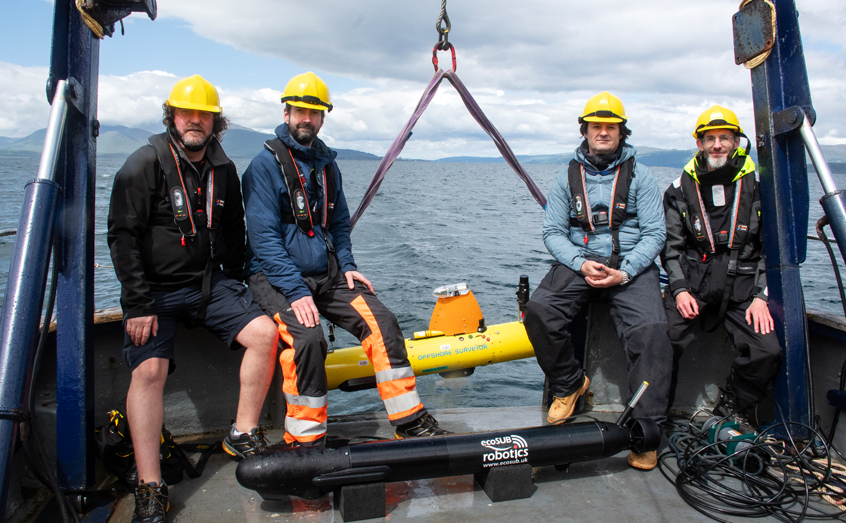
A group of UK scientists, including researchers from SAMS, used Scottish waters to help them prepare for an unprecedented study of Greenland's ice sheet.
SAMS’ Scottish Marine Robotics Facility hosted a unique trial involving robotic underwater vehicles, ahead of an ambitious Arctic research expedition departing next week.
From the institute’s research vessel Seol Mara, the scientists successfully tested the capabilities of a Teledyne Gavia and an ecoSUB to coordinate with each other using Sonardyne underwater communications, replicating a survey mission in a challenging marine environment.
The successful test helps the team to repeat the exercise in Greenland this month as part of the GIANT (Greenland Ice sheet to AtlaNtic Tipping points from ice loss) expedition on board the RRS Sir David Attenborough.
The GIANT project, led by the British Antarctic Survey, is an unprecedented study of the fjord glaciers that fringe Greenland’s ice sheet. Scientists want to understand precisely how they melt, fracture and crumble into the ocean.
The £20-million GIANT project is funded by the UK’s Advanced Research + Invention Agency (ARIA).
Through GIANT, researchers hope to understand how much meltwater is released from Greenland’s fjord glaciers, how it enters the North Atlantic Ocean and how this process influences ocean circulation and the global climate system. Despite the implications for lives and livelihoods around the world, scientists currently don’t have a clear picture of how these glaciers interact with the surrounding ocean, and the 200 or so narrow fjords have so far been impossible to capture in global computer models.
To gather unprecedented observations this summer, researchers will head to Greenland to deploy a sophisticated suite of technologies, including airborne drones, autonomous marine robots, satellites and instruments embedded directly into glacier ice. This coordinated observing system will allow researchers to study glacier behaviour on all scales, from individual cracks in the ice all the way up to the flow of meltwater and icebergs into the North Atlantic. This data collection will feed directly into multiple computer models boosted by both machine learning and AI.
As a result, scientists will incorporate Greenland’s fjords into the UK’s main climate model and develop a prototype Early Warning System that could provide advance notice of rapid glacier change.
Climate tipping points are critical thresholds within Earth’s systems – such as ice sheets, rainforests or ocean currents – beyond which change can become rapid, self-perpetuating and potentially irreversible. Despite their importance, current climate models struggle to predict exactly when these tipping points will be crossed or what their full consequences will be.

Euan Paterson
Communications and Media Officer
Euan.Paterson@sams.ac.uk
01631 559342 (direct dial)
07827 963984 (mobile)
01631 559000 (switchboard)