SAMS news room
Scientists to investigate how ocean pollutants affect human health
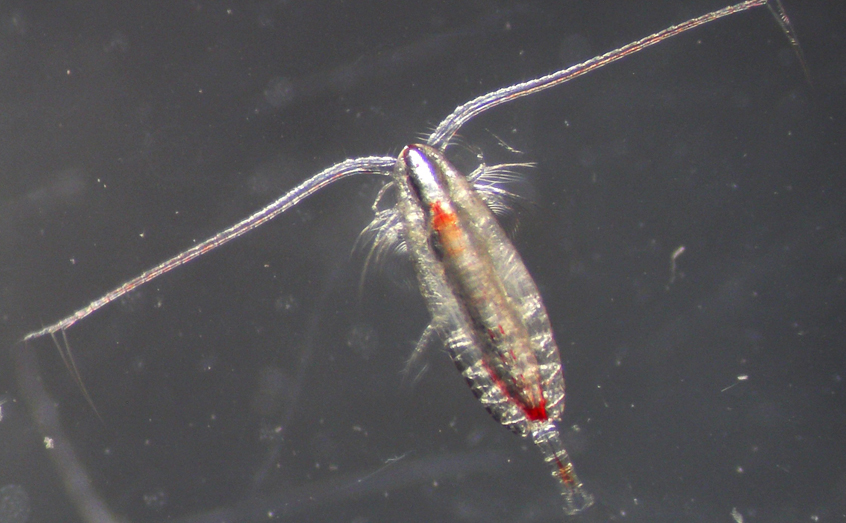
Marine scientists will, for the first time, investigate how ocean pollutants and forever chemicals may impact human health by analysing a tiny but abundant ocean creature.
Calanus copepods are crucial to the ocean food web, as these lipid-filled organisms – measuring around three millimetres in length – are high-energy food for fish, whales and birds, fuelling the marine ecosystem.
However, these lipids could also mean they are able to absorb human-made marine contaminants, including disposed pharmaceuticals, ‘forever chemicals’ (PFAS), and heavy metals used in industry.
Despite the importance of Calanus in supporting fisheries and aquaculture, as well as food security generally, the role of Calanus in contaminant uptake and transport has never before been investigated.
Dr Laura Hobbs of the Scottish Association for Marine Science (SAMS) in Oban, a partner of UHI, will lead the two-year PharmaCal research project, funded by UK Research and Innovation (UKRI), which seeks to understand the uptake of contaminants by Calanus and the pathways to human consumption.
“Contaminants released into the water can accumulate in plankton, be transported via ocean currents and animal migrations, magnify up the marine food chain, and eventually re-enter the human diet through seafood such as fish and shellfish,” said Dr Hobbs. “We want to understand the extent of these contaminants and where they ultimately end up.
“Previous work of this type has focused on freshwater environments such as rivers; there is a presumption that contaminants in the ocean are not as big a problem as in freshwater environments because the marine environment is so vast and dilute. But what if the contaminants are being heavily absorbed by Calanus near to shore and are therefore concentrated in the food chain as a result?
“PharmaCal will pull together expertise in oceanography, ecology, ecotoxicology, social science and health in an effort to measure a range of impacts based on the analysis of Calanus.”
PharmaCal will also involve researchers from NHS Highland, University of Leeds, University of Strathclyde, and fellow UHI partner the Environmental Research Institute.
While copepods are among the most abundant creatures on the planet and found globally, the research team will initially sample from the seas around Scotland.
Marine biologists will analyse the effect of contaminants on Calanus, while oceanographers on the project will use knowledge of ocean currents to understand where Calanus are transported in the ocean. A social science team will also look at the impacts that potential findings may have on fishing communities and exports, while experts in pharmaceutical public health will investigate how prescribing behaviour changes throughout the year.
This interdisciplinary approach is key to quantifying the full effect of contaminants on Calanus and human health.

Euan Paterson
Communications and Media Officer
Euan.Paterson@sams.ac.uk
01631 559342 (direct dial)
07827 963984 (mobile)
01631 559000 (switchboard)