SAMS news room
Sheina Marshall: Celebrating the queen of copepods
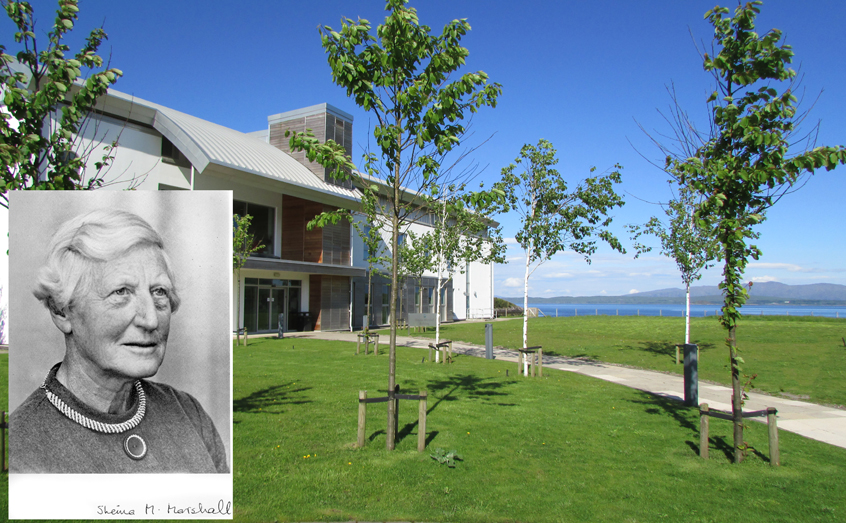
In a time when many of her female contemporaries struggled to get the recognition for their academic achievements, Sheina Marshall’s contribution to marine biology has made her one of the most famous names in SAMS’ history.
Known as the queen of copepods, Sheina Marshall OBE (1896–1977) was one of Scotland’s most influential marine biologists, whose pioneering research on plankton fundamentally shaped how scientists understand ocean ecosystems.
Her association with the Marine Biological Station in Millport (a precursor to SAMS) stretched more than 40 years, as she became arguably the international authority on the copepod Calanus, a species central to marine food webs.
Marshall and her long‑term collaborator Andrew Picken (AP) Orr transformed plankton research through decades of detailed field studies, producing books and numerous papers that became standard references for marine biologists around the world. In the 1960s, her name was considered essential reading for anyone studying marine plankton. Indeed, the Journal of Plankton Research notes that in the 1960s anyone attempting to study the biology of marine plankton would not get far into the literature without encountering her research.
Her reputation was such that prominent American marine biologist Bruce Frost named a species of copepod after her, Calanus marshallae. She was one of the first women to be elected as a Fellow of the Royal Society of Edinburgh and also became a Fellow of the Royal Society.
Her expertise on sources of agar even came to the fore during the Second World War. Marshall and AP Orr were researching the properties of seaweeds when in 1941 Japanese warplanes attacked Pearl Harbor in the USA. The American retaliation meant the UK was officially at war with Japan.
Most of the agar at that time was produced in Japan so the UK government decided Britain urgently needed to produce its own agar for medicines, vaccines, microbiology and industry. Marshall was tasked with advising government on seaweeds found on Scottish shores that could be used as a suitable source, and her work contributed to wartime vaccine development.
Sheina was 32 when she joined the Great Barrier Reef Expedition on recommendation of her zoology professor Sir Graham Kerr, a defining moment in her career. She spent 13 months on the reef, making a significant contribution in the study of coral reproduction and sediment shedding (how they get rid of sediment which is on top of them) which is still cited today.
Not only was this an ambitious marine science project, but also the first major marine science expedition to include female researchers.
After rising to the post of Deputy Director of the Marine Biological Station, she spent the latter part of her career abroad, including time at Scripps Institute of Oceanography in California.
Records held in SAMS and unearthed by SAMS outreach officer Helen McNeill showed that Marshall took copious notes and held onto much of her correspondence, especially during the war years. The find forced Helen to dig deeper into the scientist’s contribution to marine science and her personal side.
Helen said: “As well as being a first-rate marine biologist, she was also an extremely kind person and good with children. I was shown a model of a wooden lion she gave to a young child. She also liked to march across the hillsides in her tweed suit! And you had to take your turn at the washing up if you went there to high tea.
“She was unassuming, very kind and held with great respect and regard. There was a formal break for tea for staff in those days in the dining room and she resided at the head of the table with a home-knitted or crocheted tea cosy over the teapot and she poured the tea. It was all quite formal and that was during working time at the lab!”
Today, SAMS continues to mark the contribution and achievements of Sheina Marshall through its education building, erected in 2010, in her name. Each day, SAMS students pass the sign for the ‘Sheina Marshall Building’, ensuring they go into their marine science careers with the recognition of a trailblazing woman and a top class scientist.

Euan Paterson
Communications and Media Officer
Euan.Paterson@sams.ac.uk
01631 559342 (direct dial)
07827 963984 (mobile)
01631 559000 (switchboard)