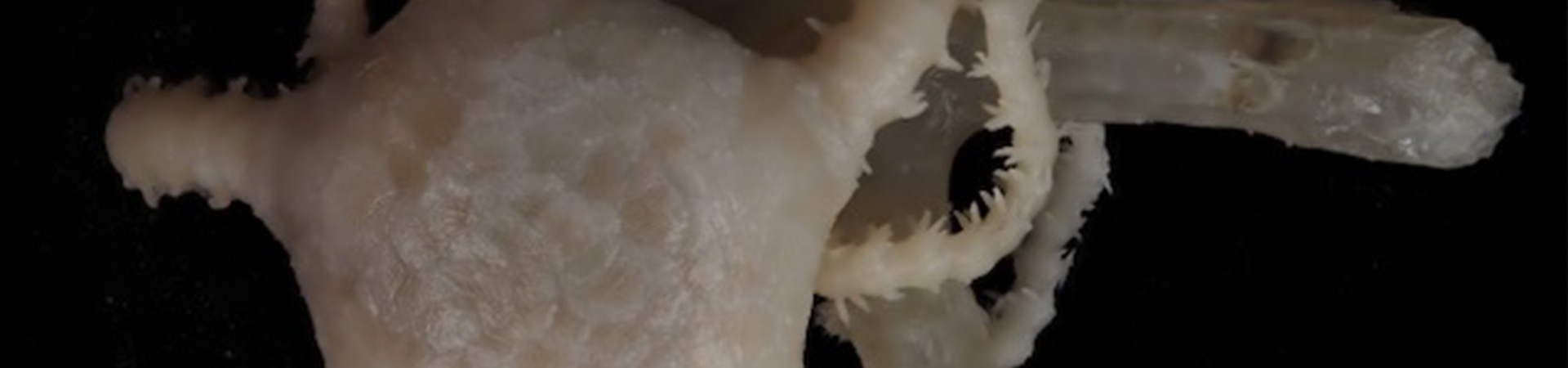

The Southern Ocean is biologically rich with much of the diversity present found among the animals living on the sea floor. Biodiversity patterns, as identified through the collections of the age of exploration (e.g. Challenger and Discovery) found that species tended to have broad distributions across Antarctic and sub-Antarctic regions with substantial connectivity inferred between island shelf regions. This pattern was again reflected in a more recent study using presence data lodged in public databases such as GBIF and SCAR-MarBIN. Large population sizes of well-connected populations across a broad area such as the Southern Ocean suggest resilient species with little conservation concern.
Investigations using DNA sequence data over the past 20 years have found that many of the species described in the 19th and early 20th century are complexes of several biological species. Some examples, such as the iconic red sea star Odontaster validus and the crinoid Promachocrinus kerguelensis have been more recently redescribed as comprising 3 and 8 species respectively, substantially increasing the recognised diversity present. However, in most cases the newly identified biological species remain undescribed and therefore unrecognised. Furthermore, most unrecognised species tend to have very limited ranges with little evidence of connectivity between populations suggesting that what was once considered a resilient species may in fact be several vulnerable species requiring attention of conservation managers.
One of the tools available to conservation management is the IUCN Red List and the associated process of evaluating the threats and vulnerabilities of species. This approach has proved very effective not only in identifying species requiring conservation management, but substantial recognition outside of experts regarding the understanding of a species red list classification, from least concern through to critically endangered. However, having a species name is an essential first step to the process, and for the undescribed species of the Southern Ocean it is unlikely that most of them will be described within the lifetime of current specialists. The unrecognised species appear forever to be hidden by their lack of species name.
The question we ask is how would “red listing” the individual unrecognised species, compared to red listing the named species, change the current impression that the Southern Ocean has a widespread, well connected and resilient fauna? How will conservation management and governance of the Southern Ocean change with more granular species distribution lists?
Research Methods
This research project will require a substantial analysis of the relevant literature to capture the details of the biology, taxonomy, biogeography and conservation status of the target species. Cruicially a review of current conservation management strategies currently in use in across the Southern Ocean would be undertaken.
The candidate would be required to undertake the IUCN Red Listing course (this is available online, free of charge). Red listing requires detailed accumulation of all biological and distribution data on the target species, along with assessment of all likely threats.
Four assesments will be made:
- A category shift score: A standardised scoring protocol will be developed and used during the assessments. E.g. Red List categories assigned scores of Least Concern =0 -> Extinct=6. A “shift” from one score to another between comparisons can then be metricised. (Wilcoxon signed-rank test on paired category scores – would report a median shift and its 95% CI
- Hidden threat rate: Proportion of genetic units whose individual category is higher than the complex.
- Management urgency delta: for each complex record whether the complex crosses a defined threshold (e.g. the Vulnerable category), and whether any of the component genetic groups cross it. What is the proportion of complexes flipping? Binomial test against a null of 0.5 (no direction of bias) would show whether there is evidence of taxonomy underestimating a threat.
- Criterion shift: determine which of the red listing criteria causes a change in category designation.
A McNemar’s test on a 2x2 table of management relevant / not relevant under lumped/split would test whether the results are systematic rather than random.
Proposed research schedule
Collecting and analysis of literature (months 1-3)
IUCN Red List assessment course (months 1-2)
Assessing 2-3 (more if possible) recognised species complexes (months 3-6)
Assessing unrecognised species (months 6-9)
Writing results and thesis (months 9-12)
Director of Studies: Dr Bernadette Snow (SAMS)
Supervisory Team: Dr Chester Sands (British Antarctic Survey)
Course Start date: February 2027
Course duration: 12 months (full time)
(the student may apply for a further 12-month extension, subject to additional fees)
Location: Based at The Scottish Association for Marine Science
How to apply
To apply, please complete and submit the following:
- Completed MRes Research Degree Student application form: RD1 Research Degree Student application MRes.docx
- A research proposal. (Please consider how you would further develop the project described here and highlight your relevant skills and work in the field. It is advisable to also include a CV.)
- Copies of all official qualification certificates and transcripts. If your official certificates/transcripts are not in English, this must be accompanied by a fully certified translation provided by a professional translator/translation company.
- For applicants whose first language is not English, an English language test certificate (IELTS or equivalent) is required and the certificate must have been gained within the past 2 years. (Check here for English language requirements: English language requirements - Approved English language qualifications)
- A copy of the photo page of your passport if you are not a UK national. Please see International entry requirements and Visa Advice. Also include any pages which indicate a right of abode in the UK.
- Copy of all your official degree transcripts and certificates. If you have not yet completed your degree, please send a transcript showing all your modules and grades.
- Please ask two Referees to submit a reference for you using: Applicant Reference Request form MRes.docx. Please ask each Referee to email the form to us directly to masters@sams.ac.uk
These documents must reach us by any deadline advertised. You can send them by email or post.
Interview information
The best candidates on paper will be invited for interview via Teams.
The MRes programme is open to UK, EU and international students.
Typical entry requirements will be based on possession of a BSc(Hons) in a relevant biological or life science subject (and depending on the candidate’s related course work, may include degrees in chemistry and engineering) at 2:1 or above, or international equivalent.
Applicants whose first language is not English must also have attained a satisfactory standard on an approved test in English (e.g. a minimum IELTS score of 6.5) or be able to demonstrate that they have adequate command of both written and spoken English to follow the programme before an offer of admission will be made. Read about English language requirements - Approved English language qualifications.
MRes programme fees comprise UHI Tuition fees for science (see link: How much will it cost? - Research postgraduate tuition fees) plus SAMS additional programme costs of £4950.
This MRes Marine Science project is self-funded.
Most students combine different funding sources such as a postgraduate student loan, savings or employer sponsorship to pay their MRes tuition fees.
UHI Alumni who have graduated with an undergraduate or postgraduate taught degree from UHI, are eligible for a 10% discount on the UHI tuition fee element of the MRes Marine Science programme.