SAMS news room
Marine robotics will aid restoration efforts on Scottish loch
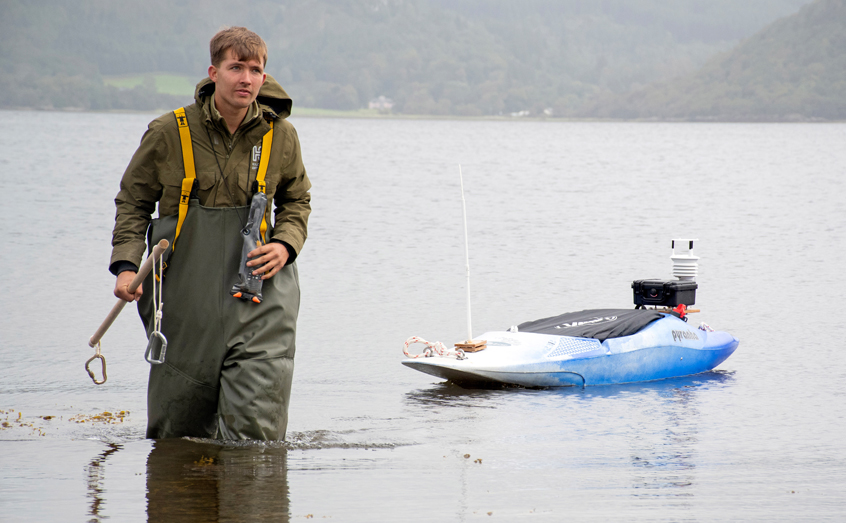
Restoration efforts on a Scottish loch have been boosted by experimental techniques using sea-going robotics that can identify the most suitable reintroduction sites.
Loch Melfort on the Kilchoan Estate, south of Oban, Argyll, has an ongoing oyster restoration project and is a sanctuary for the critically endangered flapper skate.
A collaboration involving scientists and robotics engineers from the Scottish Association for Marine Science (SAMS) Enterprise team, Unique Group and the University of Glasgow is currently planning a major survey of the loch, following a successful trial of autonomous surface vehicles.
The aim of the survey is to use the marine robotics to accurately survey the loch in order to build a habitat suitability model, which will inform the most effective site for reintroducing European flat oysters. The model will also indicate where flapper skate are most likely to lay their eggs.
Researchers on the project say a successful habitat suitability model for Loch Melfort, which has a shoreline measuring more than 22 kilometres, could pave the way for similar models to be built for similar habitats elsewhere.
Dr Phil Anderson, who heads up the Scientific Robotics Academy at SAMS Enterprise, said: “Marine and airborne robotic systems can completely transform the way we conduct and monitor restoration projects in Scotland.
“These systems can give us more coverage of an area, more quickly, collecting data that we’ve previously needed humans to record – such activity requires a lot of people over a long period of time.
“Although the potential of robotics is therefore clear to see, there is some hard work to be done in fine-tuning how that will be done. That’s what we are working on now with these Loch Melfort trials and we are fortunate to have a fantastic collaboration that draws on different expertise, covering engineering, physics and biology.”
Researchers will use sensors on board the robotics to measure the velocity, or speed, of the currents and sonar to help map the bathymetry of the loch. The survey is planned for early next year, with the data from the trial currently being examined to help inform the next steps.
Marnik van Cauter, Charity Director at Kilchoan Melfort Trust, said: “It is rewarding to see how our mission to restore the once-abundant native oyster population in Loch Melfort has brought together a network of expert organisations, helping to develop tools that will support marine restoration and conservation projects not only here at Kilchoan, but hopefully across Scotland.”
Unique Group Vice President for Survey Chris Blake said: “Unique Group is proud to support the Kilchoan Melfort Trust, SAMS and the University of Glasgow in advancing marine rewilding efforts at Loch Melfort. By deploying our fully electric Uni-Mini Unmanned Surface Vessel (USV) with Ping DSP technology, we delivered high-resolution bathymetry in ultra-shallow and environmentally sensitive areas that are inaccessible to traditional vessels.
“This collaboration provided the detailed seabed insights needed to guide habitat suitability modelling and support the long-term restoration of native European flat oyster populations. We look forward to continuing our partnership on initiatives that enhance sustainability, protect marine ecosystems and drive positive environmental impact.”
Dr Anna McGregor, senior lecturer in Ecology & Environmental Change at University of Glasgow said: “Oysters require a specific set of conditions to grow well, and after supporting Kilchoan Estate’s excellent oyster restoration work for several years to collect data on some of the biological aspects, I’m very excited to be working together with SAMS Enterprise and Unique Group to take that work a step further.
“Having the additional data available from the survey capabilities brought together through this collaboration fills in several key parameters about the physical environment that should enable us to create a much more complete picture about where oysters grow best.”

Euan Paterson
Communications and Media Officer
Euan.Paterson@sams.ac.uk
01631 559342 (direct dial)
07827 963984 (mobile)
01631 559000 (switchboard)