SAMS news room
Training course designed for era of environmental robotics
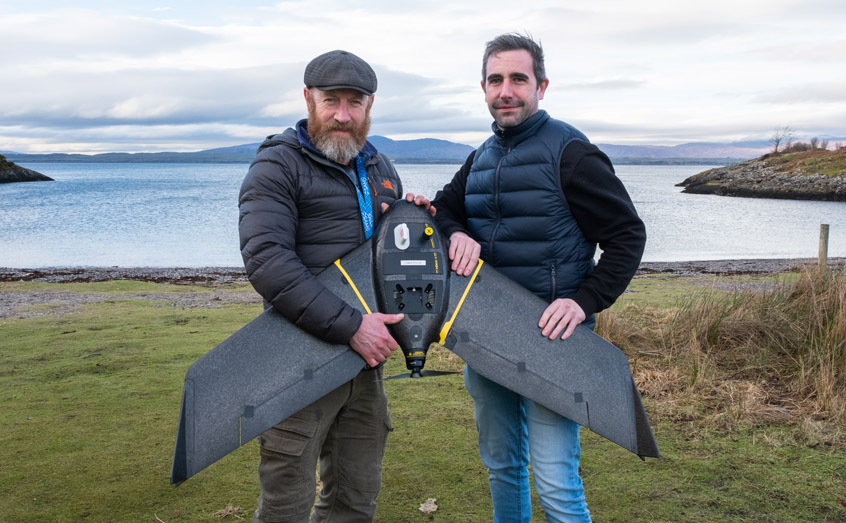
As the use of robotics in data collection increases, a leading UK environmental research charity says now is the time for researchers and other professionals to learn how to use them.
The Scientific Robotics Academy, based at the Scottish Association for Marine Science (SAMS) in Oban, will host two courses this March: ‘Environmental monitoring using autonomous platforms’ and ‘Applied photogrammetry for environmental monitoring’.
The courses come amid the rapid expansion of twin technologies of AI and robotics, which are transforming the way tasks such as survey work and species identification can be completed.
Based at beginner to intermediate level and intermediate to advanced level, respectively, the courses aim to help improve career prospects for researchers, engineers, planners and environmental managers.
Dr Phil Anderson, who heads up the Scientific Robotics Academy said: “By the end of this decade we will have seen a huge change in how we collect data. The affordability and reliability of autonomous systems means that recording data in this way is very much the current direction of travel.
“Those who are familiar with such systems and understand their strengths and limitations will be ideally placed to not just adapt to this change, but help to develop and influence how robotics is used.
“Our course gives participants practical experience with autonomous systems and the necessary data processing skills to support that.”
The new offering follows on from a development course run by the Scientific Robotics Academy last September.
University of Stirling PhD student Ximena Aguilar Vega, who was a participant on the course, said: “It has been amazing to see all the options out there in terms of robotics and all the things we could do, not just in facilitating fieldwork, but what could be achieved through various sensors being used. The course has sparked a lot of ideas!”
Another attendee, Dr Sean Morgan of Dalhousie University, Canada, said: “I’ve been using robotics in my research, but mostly autonomous surface vehicles, so it was great to see what else is available. The work we’ve done during this course on protocols and best practice has given me ideas on what I can do better.”
The new courses are backed by Argyll and Bute Council, with renewable energy developer Nadara part-sponsoring places on the courses for the first 10 applicants.
For more information on how to attend the courses, see Courses — SAMS Enterprise - Marine Consultancy
SAMS robotics case studies
Marine robotics will aid restoration on Scottish loch
Restoration efforts on a Scottish loch have been boosted by experimental techniques using sea-going robotics that can identify the most suitable reintroduction sites.
Loch Melfort on the Kilchoan Estate, south of Oban, Argyll, has an ongoing oyster restoration project and is a sanctuary for the critically endangered flapper skate.
A collaboration involving scientists and robotics engineers from the SAMS Enterprise team, Unique Group and the University of Glasgow is currently planning a major survey of the loch, following a successful trial of autonomous surface vehicles.
The aim of the survey is to use the marine robotics to accurately survey the loch in order to build a habitat suitability model, which will inform the most effective site for reintroducing European flat oysters. The model will also indicate where flapper skate are most likely to lay their eggs.
Temperature-sensing technology improving safety on snow and ice
Technology capable of monitoring snow and ice conditions in some of the most extreme and challenging environments on Earth is now providing real-world solutions to improving safety and infrastructure management in a changing climate.
SIMBA (Snow Ice Mass Balance Apparatus) is a powerful autonomous device that was originally designed as a scientific research tool for polar researchers but is now also being used to help forecast avalanche risk, assess the safety of ice roads, flood risk monitoring and protect energy infrastructure.
The device consists of a thermistor chain that measures temperature and thermal characteristics of the environment. These sensors deliver data in real time, giving detailed information on snow and ice pack conditions in regions and locations where safety is paramount.
Scientists on the hunt for ‘ghost fishing’ gear
Scientists have successfully trialled a method of finding examples of ‘ghost fishing’ and other lost creel gear in Scottish seas, as they attempt to reduce the risk of marine mammal entanglement.
Ghost fishing refers to lost fishing gear like creels that can collect on the seabed and continue to fish without ever being collected. Rope associated with the gear can also become an entanglement hazard. It is estimated that in Scottish waters approximately six humpback whales and 30 minke whales become entangled in active creel fleets each year, but the numbers that succumb to lost creel gear remains unclear.
The SAMS team used a boat to tow a side-scan sonar system, known as a towfish, which emits high-frequency sounds and records corresponding echoes, to locate objects they believed to be creels. They then deployed a remotely-operated vehicle (ROV) to observe the objects in detail and record footage of what they had found.
News - Scientists on the hunt for ‘ghost fishing’ gear — The Scottish Association for Marine Science
‘Virtual marine biologist’ reveals Greenland sealife
SAMS scientists in collaboration with colleagues from the Greenland Climate Research Centre (GCRC) have used robotics and artificial intelligence (AI) to study organisms on deep Greenlandic fjord walls for the first time.
Using an ROV, the team conducted 18 subsea video surveys to depths of 120 metres across the length of the fjord Nuup Kangerlua, near to the Greenlandic capital Nuuk.
Working with the GCRC and the NERC Arctic Office, they used the video footage to create 3D models and then applied a trained AI system, a ‘virtual marine biologist’, to identify and accurately measure the various organisms present.
Their findings will help to create and inform assessments of ecosystem composition and functioning in this hard-to-reach environment, giving an insight into how climate change may be affecting marine life there.

Euan Paterson
Communications and Media Officer
Euan.Paterson@sams.ac.uk
01631 559342 (direct dial)
07827 963984 (mobile)
01631 559000 (switchboard)